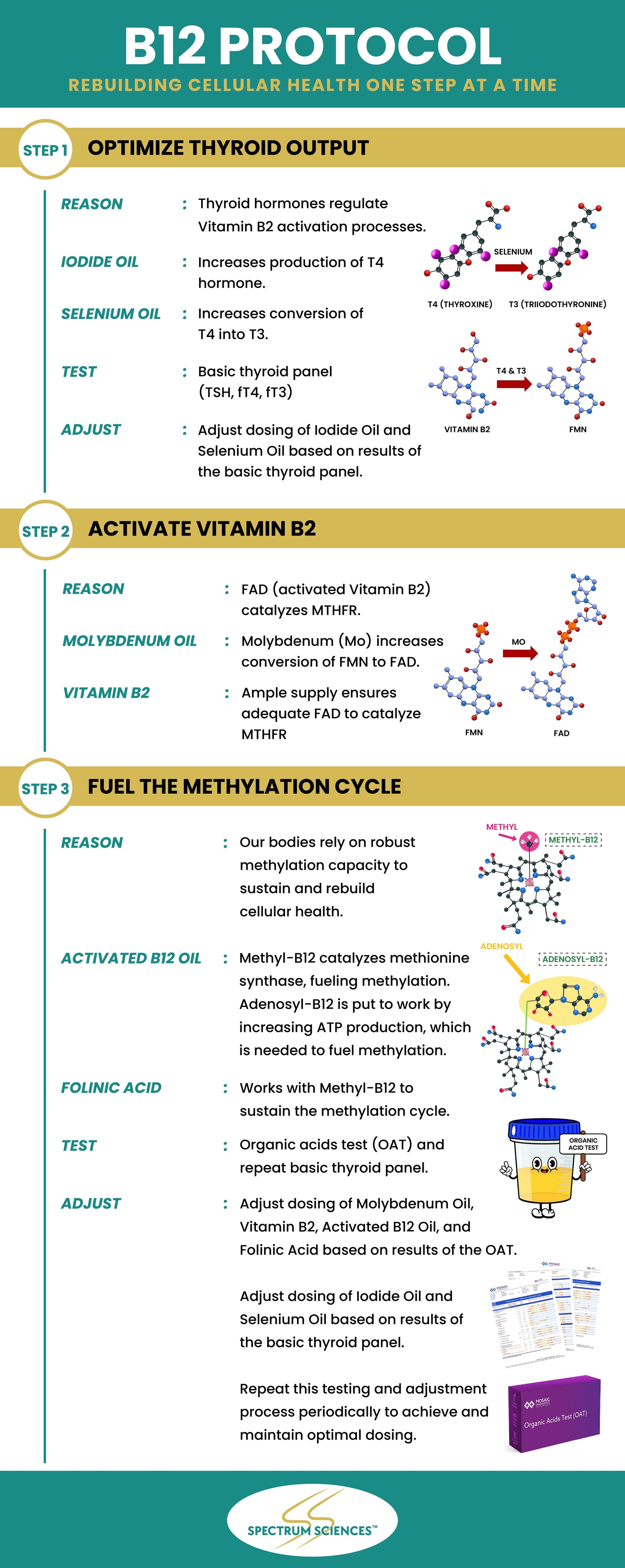

B12 Protocol
Why is vitamin B12 so important?
Vitamin B12 plays a pivotal role in what is called the methylation cycle.
This cycle acts like the transmission in your vehicle, allowing the body to select where to divert cellular energy toward different genetic, energetic, and neurological processes.
It is responsible for synthesis of creatine, phosphatidylcholine, various neurotransmitters (and their regulation), and liver detoxification. There is literally not a single function in the body that isn’t impacted by the health of your methylation cycle, because methylation is used to regulate your genes.

Cellular health is utterly dependent upon your methylation capacity. Vitamin B12 status plays a major part in how well this cycle operates, and it is often the weakest link in the cycle.
But…it isn’t as simple as taking a vitamin B12 pill and being done with it.
For starters, vitamin B12 has very limited capacity for oral absorption, which occurs through a rather complex mechanism. Some studies suggest that only about 1.5 mcg can be absorbed via the specialized protein designed for intestinal B12 uptake (known as intrinsic factor) in a single feeding. Anything in excess of 1.5 mcg can be absorbed without this special protein, but it is very inefficient, as passive diffusion only results in about 1% of the remaining dose being absorbed.
While this design allows sufficient B12 absorption for a healthy person (without extenuating stressors) to keep their methylation cycle going, those who have been dealing with a deficiency situation or those with a condition that causes high demand for methylation will find that it is impossible to replete vitamin B12 when limited to what the stomach and intestinal tract can absorb.
It’s like trying to repay a large debt one penny at a time.
Transdermal delivery is like having your rich uncle show up with his check book. The vitamin B12 debt can get paid off much faster.
However….there’s another catch.
Vitamin B12 can only be used by the cells for its methylation needs when it becomes activated. And that activation requires a few dominos to fall first.


The first domino that needs to fall is optimizing the thyroid. Standard definitions of healthy thyroid function are very lax (TSH <4.0 mIU/L), yet still excludes about 10% of the population, meaning ~10% of the population is considered hypothyroid even by the very lax standards used in allopathic medicine. When a healthy thyroid is more appropriately adjusted to TSH <1.5 mIU/L, which is where a positive impact on mitochondrial energetics is seen, this would identify over 50% of the population as hypothyroid.

Aside from fatigue, weight gain, and other unpleasant issues that a sluggish thyroid will lead to, it will also hinder your body’s ability to use vitamin B12. In fact, this is part of the reason for those particular symptoms. Optimizing the thyroid is Step 1 of the B12 Protocol, and this is accomplished by using Iodide Oil and Selenium Oil to increase thyroid hormone production.

The second domino that needs to fall is activation of vitamin B2. And just as vitamin B12 needs activation, so does vitamin B2. This is where having optimized thyroid function comes into play – it is involved in the activation of vitamin B2. Learn more about how to activate vitamin B2 using Step 2 of the B12 Protocol, which focuses on dialing in dosages of Molybdenum Oil and riboflavin (contained in Protocol Support).

The third domino that needs to fall is an optimized MTHFR enzyme. When vitamin B2 status is adequate, by making sure you are eating enough foods that contain it (such as meat and eggs) and/or supplementing, and that vitamin B2 is being activated to FMN and FAD, it will keep MTHFR running nicely (yes, even if you have the “dreaded” genetic variants that people used to get worked up about!). When MTHFR is running smoothly, it allows vitamin B12 to do its job as long as sufficient folate is provided. This process is covered by Step 3 of the B12 Protocol, which is achieved using reduced folate (contained in Protocol Support) and Activated B12 Oil.
In addition to the methylation benefits (depicted in section A of the reaction pathway below, with methylcobalamin labeled "M-B12"), the B12 Protocol also provides mitochondrial benefits (depicted in section B of the reaction pathway below) due to the role of adenosylcobalamin (labeled "A-B12") in ATP production.

This 3-step sequence should be monitored and fine-tuned to your individual biochemistry according to the graphical summary at the bottom of this page. Note that a basic thyroid panel and a urinary Organic Acids Test (OAT) are not absolutely required if a person is skilled at gauging symptom feedback, but these tests are often very helpful in adjusting dosages.
The lab tests mentioned here can be ordered using the links provided on our lab testing page.
To learn more, follow our education series blog here.