
Aging Beautifully With B12

With age comes wisdom. It is common to fantasize about the fortunes we might have realized in our youth, had we been equipped during our younger years with the wisdom that only comes with age.
It is also common to fantasize about having the youthful energy and sharp mind that our younger (albeit less wise) self possessed.
After all, reduced energy and slower cognition are just expected effects of getting older. You can think of it as a programmed deterioration of the body.
This process happens in large part because of reduced methylation capacity that comes with age. Methylation is one of the main mechanisms by which cells regulate genetic expression, turning genes up or down depending on feedback signals from the body and from the environment.
When methylation capacity decreases, our ability to respond to stressors is diminished.
Young people can get away with A LOT more things than older adults can. At least if we care about how we feel and our performance. You are reading this, so I assume you do care. Read on to learn what can be done to halt age-related fatigue and cognitive decline in their tracks.
This age-related performance decline is due in large part because the body's methylation capacity is reduced, and therefore less capable of bouncing back from stressors by regulating genetic expression.
It is becoming more and more important to protect ourselves from the onslaught of stressors in today's world. Doing nothing has costly consequences.
Our environment is riddled with stressors, from chemicals in the food/water/air supply, electromagnetic noise, and man-made pathogens activating our immune systems 24/7.
Look at what is happening to the rate of chronic diseases. Just considering the global dementia figures, the rate of Alzheimer's disease and other dementias increased to nearly 2.5 times from the prevalence in 1990 to that of 2019 (Li X, et al, 2022).
This data was published BEFORE the COVID pandemic and destructive government mandates, meaning the data collected since then has not had enough time to be analyzed and published. The preliminary data suggests this problem is now growing at an even more alarming rate.
In fact, two reports published within the last year both predict that the dementia rate will more than double by 2060 based on current projections (AD, 2024) (Fang, et al, 2025).
But seniors are not the only demographic at high risk. The global prevalence of dementia among individuals under 70 also increased significantly, growing 2.28 times the level from 1990 to 2021 (Li Z, et al, 2024). We are clearly in the midst of a looming crisis.

The chronic disease epidemic is finally getting the attention it deserves at the National Institutes of Health. Their findings will almost certainly include in their conclusions that metabolic health (which includes methylation capacity) is a primary determining factor in the deteriorating health of our country - and globally.
With age, the chances of being diagnosed with a chronic disease increases. Obesity, insulin resistance, and type 2 diabetes are strongly correlated with age. Large-scale studies confirm that the prevalence of metabolic syndrome rises rapidly with age in both men and women (Bae, 2021).
In summary, the older you are, the higher your risk of being diagnosed with a chronic metabolic disease. If you like the idea of aging more like 45/47 and less like 46, read on.
And while the full metabolic landscape of aging is complex, we know that methylation capacity is one of the biggest contributors to cellular aging, loss of tissue function, and higher susceptibility to age-related diseases.

Multiple studies have shown that impaired methylation status—often measured by the ratio of methionine to homocysteine in the blood—is linked to an increased risk of developing dementia and to greater structural brain changes, such as brain tissue volume loss, in older adults (Hooshmond, 2019). A higher methionine to homocysteine ratio, reflecting better methylation capacity, is associated with a decreased risk of dementia and slower brain atrophy.
And researchers have proven that Vitamin B12 replacement therapy improves methylation capacity.
A multicenter study of 202 patients with early warning signs of cognitive impairment found that elevated homocysteine levels (a B12 deficiency marker) were linked to neuronal damage and dementia risk (Jatoi, et al, 2020).
The study also showed that patients with serum B12 levels <100 pg/mL (severe deficiency) showed limited improvement, suggesting chronic deficiency may cause irreversible neurological damage.
However, in those who were treated with vitamin B12 injections found that 84% reported symptomatic improvement in memory and focus, while 78% showed improved Mini-Mental State Examination scores.
"Normal" B12 Levels May Be Insufficient for Brain Health
More doctors are beginning to routinely screen their patients for adequate levels of vitamin B12. However, the reference ranges used by the laboratories and interpreted by doctors are calculated based on the general population, and many of those individuals are deficient. This taints the reference range to make the patient's levels appear more adequate than they really are.
An analogy that most people understand is that lab reference ranges based on the general population can be a bit like figuring out the average weight at a Weight Watchers meeting and assuming that is the population average. Using the Weight Watchers data, a person who weighs 245 pounds might be led to believe they are in the middle of the range and have no need to lose weight.

Dementia researchers are beginning to call for revisions in the vitamin B12 reference ranges based on a similar concept.
A UCSF study of 231 older adults (mean age 71) found that vitamin B12 blood levels on the lower half of the reference range, but still considered "normal", correlated with three significant indicators of cognitive decline (Koralnik, et al, 2020). These indicators include:
- Slower cognitive processing speeds
- Brain lesions linked to cognitive decline
- Higher blood levels of T-Tau protein, a neurodegeneration biomarker
Because of these findings, researchers argue that current B12 thresholds (≥148 pmol/L) may need revision, as subtle deficits persist even at "sufficient" levels. The longer these subtle deficits persist, the further the cognitive decline may progress, and the patient's condition becomes more difficult to manage.
Evidence of B12’s Protective Role
A 2010 study suggested that vitamin B12 may reduce dementia risk by lowering homocysteine (Hooshmand, et al, 2010).
Researchers have proposed that vitamin B12 deficiency may result in cognitive decline from two related mechanisms. The key mechanisms proposed include:
- Homocysteine Toxicity: Elevated homocysteine, which results from B12 deficiency, damages neurons and blood vessels, accelerating cognitive decline.
- Impaired Myelination: B12 is critical for nerve insulation (myelin), and deficiency disrupts brain signal transmission.
Clinical Implications
 Screening for B12 deficiency, even in asymptomatic patients, may help mitigate dementia risk. B12 replacement therapy (e.g., intramuscular injections) improves outcomes in deficient patients, particularly when initiated early.
However, many doctors are still reluctant to order blood tests for items that are considered "alternative" medicine.
Furthermore, if you convince your doctor to run the test, and it shows low levels of vitamin B12, many doctors still erroneously believe that a it can be fixed easily by taking a pill that contains some vitamin B12.
If this were true, vitamin B12 deficiency wouldn't be a worldwide problem. The average US diet provides a daily intake of between 3.66 - 5.84 micrograms of vitamin B12, which is well above the 2.4 micrograms recommended by the NIH.
Clearly, there is a bigger problem than what a poorly-absorbed capsule or even a carnivorous diet can solve.
In B12 replacement therapy, it is common for doctors to prescribe 1000 mcg by injection every month to maintain adequate blood levels in their patients. That amounts to about 12 times the monthly RDA - by injection! This is in addition to the amount the patient receives through their diet.
The reason injections are much more effective than capsules, in addition to the massive dose they supply, is due to the fact that oral administration of vitamin B12 is poorly absorbed.
We wish it were as simple as taking a daily capsule of vitamin B12 to replete the brain of this vital nutrient, but unfortunately, that is not the case. Most of the vitamin B12 contained in capsules simply ends up in the toilet.

Vitamin B12 absorption in the GI tract is facilitated by a protein known as intrinsic factor, which acts as a shuttle from the gut to systemic circulation. It has been shown that intrinsic factor is saturated at 10 micrograms, meaning oral absorption is limited to about 10 micrograms per feeding. This falls far short of the dosages used in any of the replacement therapy protocols used by these teams of researchers.
In addition to the absorption problem, scientists also believe that there is significant benefit to sustained release of vitamin B12 into systemic circulation, which maintains elevated blood levels and optimizes intracellular absorption.
This is a big reason why most doctors who prescribe vitamin B12 replacement therapy for their patients initially prescribe smaller injection doses (~100 micrograms) on a daily basis for the first 1-2 weeks, followed by a gradual taper to monthly injections.
Continuing with daily injections would provide a greater benefit, but this comes at the risk of poor patient compliance. The compromise is that doctors start their patient on a frequent injection regiment, but switch to less frequent injections so they continue to retain some of the benefits by not stopping treatment altogether.
But what if a person could enjoy the convenience of a daily, at-home supplement, and the power of a daily high-dose injection?
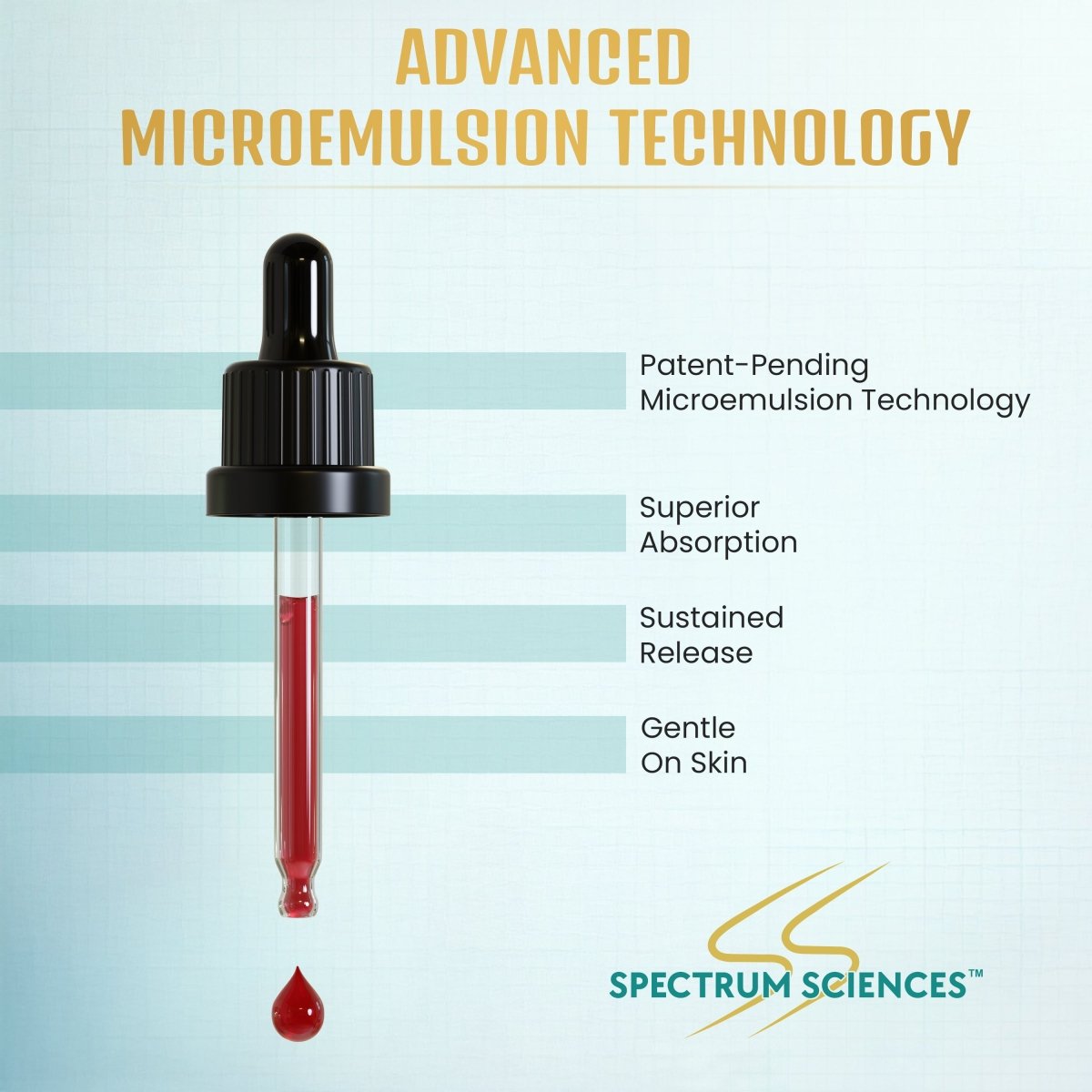
To meet these criteria, we have developed cutting-edge microemulsion transdermal technology, vastly improving vitamin B12 absorption compared to oral capsules and powders, allowing for an at-home option that provides doses used in a clinical setting.

This method also provides the benefits of slow release into systemic circulation, mimicking the results of daily injections without the hassle of prescriptions, needles, and insurance claim denials.
Activated B12 Oil readily penetrates through the deepest layers of the skin, delivering both active forms of Vitamin B12 into the blood stream. Oral B12 supplements cannot compare. This efficient and convenient delivery system helps to ensure compliance, consistency, and efficacy, encouraging a long-term commitment to better health.
How It Works
Studies show that microemulsions are a safe and effective way to deliver substances across the skin into systemic circulation. The microemulsion particle must be small enough to diffuse into the upper layers of the skin and efficiently fill hair follicle canals, releasing their contents into circulation. Smaller microemulsion particles result in more effective and deeper skin permeation due to their increased surface area to volume ratio, giving them the ability to bypass the skin barrier. This makes topical application of the microemulsion a superior method for transdermal delivery.

Our team has meticulously developed and tested various formulations and proportions, crafting the most efficient microstructure, allowing these particles containing vitamin B12 to permeate the skin.
We are on a mission to improve health, so all ingredients we use are recognized as safe for sustained contact with the skin and are quickly metabolized and cleared by the body.
Spectrum Sciences Activated B12 Oil is a topical serum supplying the critical nutrient, Vitamin B12 in its two active forms, methylcobalamin and adenosylcobalamin. Methylcobalamin is needed to support the methylation cycle, while adenosylcobalamin is needed by the mitochondria for energy production. Inclusion of the two active forms explains why our formula is a potent weapon against both age-related cognitive decline and fatigue.
Sustained systemic delivery mimics the pattern of daily injections without the hassles and costs associated with doctor's visits, needles, pharmacies and insurance companies.
That means you get not only a higher blood level of B12 but also a steadier blood level of B12 with transdermal application when compared to oral capsules.
Preventing the dementia epidemic that researchers are predicting to happen by 2060 could be as simple as repleting vitamin B12 levels in susceptible individuals. Spectrum Sciences is offering a pound of prevention at the cost of a half ounce bottle.
And for being an Epoch Times reader, you have an opportunity to save 15% off your entire order when you use the code EPOCH15.
Spectrum Sciences B12 Protocol capitalizes on the features that researchers have used to reverse dementia symptoms in their subjects, inspired by best practices in medicine.
Now, with this technology available over the counter, preventing and reversing symptoms of dementia are more convenient and affordable than ever.
One of our customers had this to say about our Activated B12 Oil:
"I am EXTREMELY pleased with the results of my CBC. Red blood cell size (MCV) has NEVER been in range in my LONG LIFE! Thank you!"
This customer helped her son reverse a long-standing B12 deficiency:
"After 10 consecutive years of having elevated MMA (severe B12 deficiency), he received a within range MMA result today!!! We've been doing the protocol for a few months and it is working. (We've been working on it for years doing other things that never worked). There is hope to turn things around, for sure! I switched to Spectrum Sciences oil and it's been life changing for my son!"
We followed up with her several weeks later to make sure it wasn't just a temporary benefit she was seeing. This is what she had to say:
"He's been feeling better and better each week. I'm so excited for him. His mood has improved dramatically and also his levels of energy. He's so much more talkative too...no more brain fog, better immune system, and last but not least his better ability to cope in stressful situations...I truly wish this for all kids and adults that struggle with B12 deficiency. The oils were truly the missing piece for him."

Are you beginning to notice the effects of age on your body and mind? Perhaps you are noticing your vitality isn't quite what it used to be.
We are getting reports from all around the world of increased energy and improved mental faculties like the customer testimonials mentioned above. Lab results are changing for the first time in their lives.
It's because our Activated B12 Oil works. This patent-pending technology makes B12 replacement therapy simple, effective, and affordable.
Just apply 8 drops to the skin, rub it in, and let it go to work. And for being an Epoch Times reader, you can save 15% off your entire order by using the code EPOCH15 at checkout.

Oral capsules and drink mixes simply do not work - that is why our product features patent pending microemulsion transdermal technology. While oral absorption is adequate for maintaining nutritional status of an otherwise healthy individual, it cannot supply the high doses or sustained release required for therapeutic benefits. With Activated B12 Oil, you can experience the full power of this life-changing therapy.
Vitamin B12 is the anti-dementia factor that scientists predict can put a halt to the epidemic looming by 2060. If you are like most, becoming part of that statistic is not on your bucket list.
Give your energy levels and cognitive faculties some powerful nourishment and save on our Activated B12 Oil today - only $29.75 with code EPOCH15 at checkout!
These BIG, BEAUTIFUL savings can help Make Aging Great Again!



Proudly Made in the USA