

Best Vitamin B12 Supplement for Vegans: The Oil Advantage
A pill isn’t the only route to B12 support. If you follow a vegan diet and still feel tired while taking a vitamin b12 supplement for vegans, it’s reasonable to review the product’s form, directions, and delivery method. B12 supports energy metabolism and nerve function, so a reliable source matters.
Oral B12 absorption involves the digestive system and a protein called intrinsic factor, although supplements can also be absorbed in small amounts through another pathway. Some health conditions and digestive changes can affect absorption. Injections may not suit everyone, either. The right option depends on your needs, not just the label on a bottle.
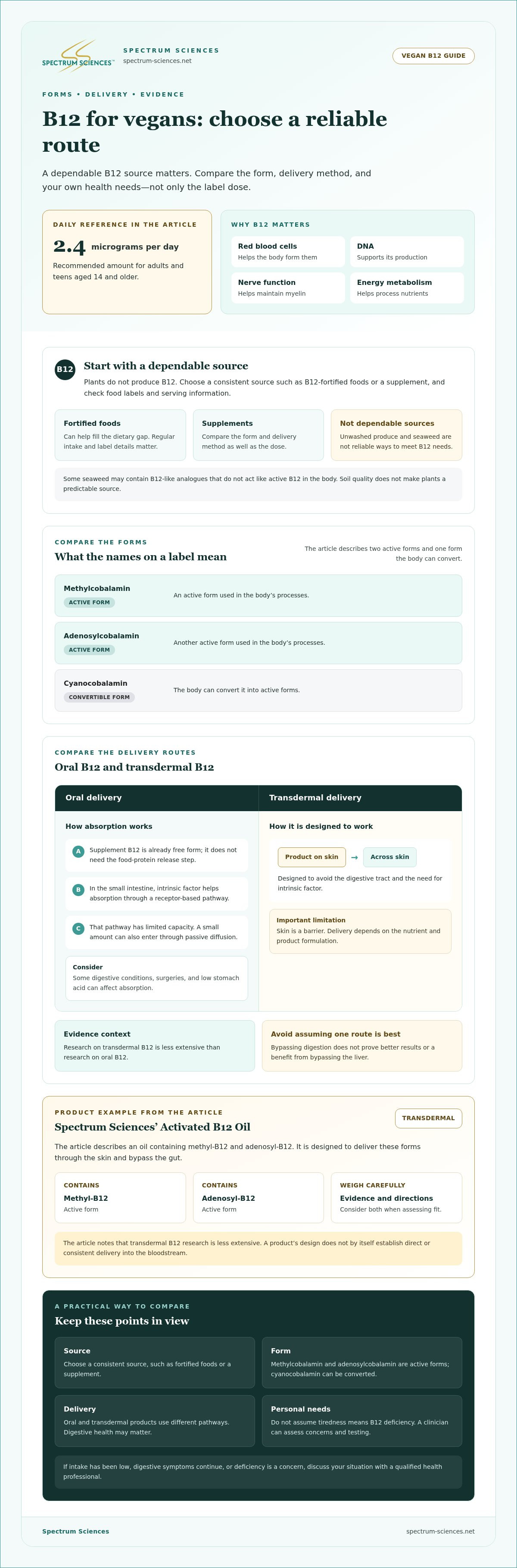
This article explains how B12 forms differ and why methylcobalamin and adenosylcobalamin are considered active forms. It also looks at Spectrum Sciences’ Activated B12 Oil, which combines these forms in a transdermal product designed to bypass the gut. Research on transdermal B12 is less extensive than research on oral B12, so it’s important to weigh its potential alongside its limitations. Use the guidance here to compare options and identify questions to discuss with a qualified health professional.
Key Takeaways
- A vegan diet calls for a dependable B12 source. B12 plays roles in red blood cell formation and DNA synthesis.
- Choosing a vitamin b12 supplement for vegans involves more than comparing doses. Consider the form, delivery method, and your own needs.
- Methylcobalamin and adenosylcobalamin are active forms. Cyanocobalamin is another form the body can convert into active forms.
- Digestive health may be relevant when comparing oral supplements with transdermal delivery.
- Spectrum Sciences’ Activated B12 Oil contains methyl-B12 and adenosyl-B12 in a transdermal format. Consider the evidence and product directions when deciding whether it suits you.
Understanding the Essential Role of a Vitamin B12 Supplement for Vegans
For people following a fully plant-based diet, a dependable source of B12 is essential. Plants don’t produce this vitamin, so a vitamin b12 supplement for vegans or regular intake of fortified foods can help fill a dietary gap. The National Institutes of Health lists 2.4 micrograms per day as the recommended amount for adults and teens aged 14 and older.
The Biological Necessity of B12
B12 helps the body form red blood cells and make DNA. It also supports the maintenance of myelin, the protective layer around nerves. In metabolism, B12 helps process nutrients and support cellular energy production. It doesn’t work like a stimulant, but low levels can affect normal body functions.
Deficiency may develop gradually, and early signs such as tiredness can have many causes. Waiting for clear symptoms isn’t a reliable way to protect your health. A clinician can assess concerns and recommend appropriate testing, especially if your intake has been low for some time.
Why Plants Cannot Provide Sufficient B12
B12 is made by certain microorganisms, not by plants themselves. Unwashed produce is not a dependable source because the amount and type of microbes on it can vary. Modern food washing and sanitation also remove soil and surface microbes. Seaweed isn’t a reliable substitute either. Some varieties contain B12-like analogues that may not act like active B12 in the body.
That distinction matters when choosing a source. Active forms, such as methylcobalamin and adenosylcobalamin, are forms the body uses in its processes. Some plant foods may contain inactive analogues that can’t be counted on to meet needs. Soil quality alone doesn’t make crops a reliable source because plants don’t absorb and provide B12 in a predictable way. For an overview of its forms and roles, see Vitamin B12.
Choose a consistent source, such as B12-fortified foods or a supplement, rather than relying on unwashed vegetables or seaweed. Check food labels for B12 content and serving information, and consider how regularly you eat those foods. If you’re unsure whether your diet provides enough, discuss your intake and any symptoms with a qualified health professional.
Comparing Oral Delivery and Transdermal B12 Absorption
Choosing a vitamin b12 supplement for vegans means looking beyond the dose on the label. Oral B12 absorption depends partly on the digestive system, but it isn’t accurate to say that all pills fail or that stomach acid destroys B12. The route, dose, health history, and supplement form can all matter.
The Digestive Steps Behind Oral B12
B12 in food must first separate from food proteins, a step that involves stomach acid and enzymes. B12 in supplements is already in a free form, so it doesn’t need that same release step. In the small intestine, intrinsic factor helps the body absorb B12 through a receptor-based pathway. This pathway has limited capacity, while a small amount of a high oral dose can also enter through passive diffusion.
The NIH explains these absorption routes in its NIH Vitamin B12 Fact Sheet. Some digestive conditions, certain surgeries, and low stomach acid can affect B12 absorption. The broad phrase “leaky gut” alone doesn’t show that someone cannot absorb oral B12. If you have ongoing digestive symptoms or suspect deficiency, ask a health professional about assessment rather than assuming a particular supplement route will solve it.
What Transdermal Delivery Can and Cannot Tell Us
Transdermal products are designed to deliver a nutrient across the skin, avoiding the digestive tract and the need for intrinsic factor. Skin is a protective barrier, however, and a nutrient’s ability to cross it depends on its properties and the product’s formulation. Evidence for transdermal B12 is less extensive than evidence for oral B12, so claims of direct or consistent delivery into the bloodstream should be viewed with care.
Bypassing digestion also doesn’t automatically mean bypassing the liver in a way that improves B12 results. That benefit hasn’t been established here. Oral B12 enters the body through intestinal absorption. Transdermal delivery would need to cross the skin before reaching circulation. These are different pathways, but one shouldn’t be called superior for everyone without strong comparative evidence.
For a closer look at how delivery methods differ, read transdermal delivery versus oral supplements. Spectrum Sciences’ Activated B12 Oil combines methyl-B12 and adenosyl-B12 in a transdermal format designed to bypass the gut. Review the Activated B12 Oil details to understand its form and delivery approach, and discuss your options with a health professional if you’re unsure what suits you.
Methylcobalamin and Adenosylcobalamin: The Active Form Advantage
When comparing a vitamin b12 supplement for vegans, check the form as well as the dose. Many supplements use cyanocobalamin, a stable synthetic form. The body can convert it into the coenzyme forms it uses, methylcobalamin and adenosylcobalamin. Cyanocobalamin contains a cyanide group, but that doesn’t mean normal supplement use causes cyanide poisoning. Avoid choosing based on fear-based claims about this ingredient.
Methylcobalamin and adenosylcobalamin are active forms of B12 involved in different processes. The Harvard Nutrition Source also emphasizes that vegans need a reliable B12 source, such as fortified foods or supplements. Form matters, but adequate intake and consistent use matter too.
Methylcobalamin and Methylation
Methylcobalamin helps an enzyme transfer a methyl group during a key reaction in the body’s methylation cycle. This cycle supports normal cell processes, including the handling of homocysteine and the production of important compounds. B12 also supports normal nerve function. These roles don’t prove that a particular B12 form improves mood or cognitive performance in someone who already has adequate B12.
Topical methylcobalamin is one delivery option. Spectrum Sciences’ guide to transdermal B12 oil explains the company’s approach. Transdermal delivery is designed to bypass the gut, though evidence for this route is less extensive than for oral B12. The form and the delivery method are separate factors to consider.
Adenosylcobalamin and Mitochondrial Metabolism
Adenosylcobalamin works as a cofactor for an enzyme involved in metabolism inside mitochondria, the structures that help cells process fuel. This makes it relevant to cellular energy pathways, but it shouldn’t be described as a muscle-building or tissue-repair agent. Those outcomes depend on many factors, and B12 supplements aren’t a substitute for care when symptoms have another cause.
Using methylcobalamin and adenosylcobalamin together supplies the two coenzyme forms used in distinct B12-dependent reactions. That’s a practical way to include both forms in one formula, not proof that the combination produces a special effect beyond meeting B12 needs. Spectrum Sciences’ Activated B12 Oil combines both forms in a transdermal product designed to bypass digestive absorption. Review the Activated B12 Oil details to understand its form and delivery approach, then consider your needs with a qualified health professional.
How to Choose the Most Effective B12 Supplement for Your Lifestyle
The right vitamin b12 supplement for vegans should fit your diet, health needs, and routine. Don’t choose by dose alone. Check the B12 form, delivery method, ingredient list, serving directions, and evidence behind claims about absorption. A higher dose doesn’t automatically mean better uptake or better results.
When comparing pills with transdermal oils, consider your digestive health and the limits of the available evidence. Oral B12 works well for many people, but some health conditions and medicines can affect absorption. Transdermal products are designed to bypass the gut, though research on this route is more limited. If you’re unsure, discuss your options with a qualified health professional.
Vegan status can also involve ingredients beyond B12. Review the full label for animal-derived binders, coatings, or other ingredients, and check for dyes or artificial flavors if you prefer to avoid them. Look for clear ingredient details and information about quality testing, including testing for heavy metals and other contaminants. Don’t assume a product has been tested unless the maker provides evidence.
Signs Your Current Supplement May Need a Review
Ongoing fatigue, brain fog, or changes in sensation while taking oral B12 deserve attention. These symptoms have many possible causes, so they can’t show on their own that your supplement isn’t working. A clinician can review your diet, health history, and test results instead of relying on symptoms alone.
A serum B12 result is one part of an assessment. In some cases, a clinician may consider other markers, such as methylmalonic acid, to help assess B12 status. A normal-looking result doesn’t prove that cells are “starving,” and symptoms alone don’t establish a functional deficiency. For more background on care options, read Vitamin B12 deficiency treatment.
Purity, Testing, and Tracking
Spectrum Sciences offers Organic Acids Test (OAT) testing to assist with managing methylation and nutrient absorption protocols. OAT results shouldn’t be treated as proof that B12 is reaching cells or as a replacement for clinical assessment of B12 status. Ask a health professional which tests fit your situation.
After choosing a supplement, follow its directions and keep a simple record of use and how you feel. Energy and mental clarity can be useful observations, but they aren’t reliable measures of B12 levels. Use them as discussion points, not as a diagnosis or a reason to change your dose without guidance.
Activated B12 Oil: The Spectrum Sciences Approach to Vegan Health
If you’re comparing a vitamin b12 supplement for vegans, Spectrum Sciences offers an oil that combines two active forms. Its Activated B12 Oil contains methyl-B12 and adenosyl-B12 in a transdermal format designed to bypass the digestive tract. This may suit people seeking an alternative to pills, but no delivery method guarantees a particular result for everyone.
Why Consider a Transdermal Oil?
The oil brings together methylcobalamin and adenosylcobalamin, forms used in different B12-dependent processes. Its delivery method is intended to avoid the gut and the intrinsic factor pathway involved in absorbing B12 from food. That design may be relevant if you prefer not to swallow pills or want to consider a non-oral option.
There are limits to keep in mind. Research on transdermal B12 is less extensive than research on oral B12, and a product’s format alone doesn’t prove how much reaches circulation or whether it improves symptoms. Read the label, review the evidence, and discuss B12 concerns with a qualified health professional. Spectrum Sciences’ guide to choosing B12 oils offers more information about this delivery approach.
Making It Part of Your Routine
Use the oil only as directed on its label. Don’t increase the amount or apply it more often in hopes of faster results. If you’re also taking other supplements, check their ingredients and discuss the combination with a health professional. This can be especially helpful when considering minerals, since individual needs can differ.
Keep your routine simple and consistent. Follow the product directions, note any changes you notice, and bring questions or ongoing symptoms to a clinician. Changes in energy or focus can have many causes, so they can’t confirm that B12 is working or that your levels are adequate.
Spectrum Sciences also offers transdermal iodine, selenium, and molybdenum oils alongside its B12 oil. These products have different purposes, so don’t assume you need to combine them. Choose based on your needs and reliable guidance rather than adding several supplements at once.
The oil format provides another option for people seeking B12 support without relying on a pill. Compare its active forms, directions, and delivery claims with your priorities, and ask a health professional if you’re unsure which approach fits your situation.
Choose B12 Support That Fits Your Needs
Choosing a vitamin b12 supplement for vegans means weighing the form, delivery method, and evidence behind each option. A steady, reliable B12 source matters, and ongoing symptoms deserve careful assessment rather than guesswork.
Spectrum Sciences’ Activated B12 Oil combines methyl-B12 and adenosyl-B12 in a transdermal formula designed to bypass the gut. This may appeal if you prefer an option outside the usual pill format. Research on transdermal B12 is less extensive than research on oral B12, so consider the available evidence and discuss your needs with a qualified health professional.
The best choice is one you understand and can use as directed. Review the ingredients, consider your health history, and seek professional guidance if you’re unsure about your B12 status or ongoing symptoms.
With clear information and thoughtful support, you can make a choice that fits your needs. Explore Spectrum Sciences’ Activated B12 Oil to review its ingredients and transdermal delivery approach.
Frequently Asked Questions
Is a vitamin b12 supplement for vegans really necessary if I eat fortified cereal?
It may be, depending on how much fortified cereal you eat and how much B12 each serving provides. Check the nutrition label and compare it with your needs. Also consider whether you eat it regularly and get B12 from other fortified foods. If your intake is uncertain, discuss your diet with a qualified health professional. A consistent, reliable B12 source is important on a vegan diet.
What is the difference between methylcobalamin and cyanocobalamin?
Methylcobalamin is one of the active coenzyme forms of B12, while cyanocobalamin is a stable synthetic form that the body converts into active forms. Cyanocobalamin contains a cyanide group, but this fact alone doesn’t mean normal supplement use is harmful. Both forms can provide B12. Compare the label, serving directions, and your needs rather than assuming one form is right for everyone.
How can I tell if I am not absorbing my oral B12 supplement?
You can’t tell from symptoms alone. Fatigue, tingling, or changes in focus can have many causes, and taking a supplement doesn’t confirm that your B12 status is adequate. A health professional can review your diet, health history, and lab results. Depending on your situation, testing may include B12 and other markers, such as methylmalonic acid. Don’t change your dose based only on how you feel.
Why is transdermal B12 oil considered better than standard pills?
Transdermal B12 oil is designed to deliver B12 through the skin, avoiding digestion and the intrinsic factor pathway used for much oral B12 absorption. That may appeal to people who prefer not to take pills or have concerns about digestion. However, “better” isn’t proven for everyone. Evidence for transdermal B12 is less extensive than evidence for oral B12, so consider the limits and discuss options with a health professional.
Can vegans get enough B12 from nutritional yeast alone?
Only if the nutritional yeast is fortified with B12 and your usual serving provides enough to meet your needs. Some nutritional yeast products aren’t fortified, so check the label for B12 and serving size. Don’t assume the yeast itself naturally supplies a reliable amount. If you use it as your main source, consider how often you eat it and review your total B12 intake with a qualified health professional.
What are the symptoms of a functional B12 deficiency?
Possible signs of low B12 include fatigue, weakness, numbness or tingling, and problems with balance or memory. These symptoms can also come from other health issues, so they don’t confirm a deficiency. “Functional deficiency” may describe concern that B12 isn’t being used well, but a normal result doesn’t prove that cells are deficient. Seek clinical assessment instead of self-diagnosing from symptoms or one test.
How long does it take to feel the effects of a transdermal B12 oil?
There’s no reliable set timeline for feeling a change from transdermal B12 oil. Effects can depend on the reason for symptoms, a person’s B12 status, and other health factors. Some people may not notice a clear change, and feeling better doesn’t confirm that B12 levels are adequate. Follow the product directions and speak with a health professional about persistent symptoms or how to assess your B12 status.
Is it possible to take too much vitamin B12 as a vegan?
The NIH has not set a tolerable upper intake level for B12 because evidence has not established a level that causes harm in healthy people. Still, follow the product label and don’t assume that more is always better. If you take several supplements, check for overlapping B12 amounts. Ask a health professional for advice if you have a health condition, take medicines, or are unsure what amount suits you.