

Topical vs. Oral B12: What's Better for Your Child?
Getting a child to take a daily vitamin can be a struggle, especially when that child has sensory sensitivities, oral aversions, or simply refuses to swallow pills. Vitamin B12 supports methylation and neurological health, and a deficiency can make a child feel tired, unfocused, or irritable. For parents, the practical question is not just which supplement is most effective, but which form the child will actually accept. Comparing topical vs oral B12 means looking at absorption, convenience, and the real-world challenge of getting the dose in without a fight.
Why Some Children Refuse B12 Supplements
Swallowing pills is a skill, not a given. Many toddlers and young children simply cannot do it yet. Children with autism may have oral motor challenges, sensory sensitivities, or strong preferences about taste, texture, and temperature. A vitamin that smells fine to an adult can be overwhelming to a child. The result is that parents often try several products before finding one the child will accept.
Injections add another layer of difficulty. A child who fears needles may cry, squirm, or develop anxiety around medical visits. Even a cooperative child needs a patient person to give the shot. For families, the convenience of a daily supplement at home is a major advantage, which is why non-injection routes deserve a closer look.
Why the Delivery Method Matters
For a nutrient like B12, the route of delivery can change everything. Research describes several methods used to treat vitamin B12 deficiency, including intramuscular (IM) injections, oral tablets, sublingual drops, and intranasal preparations. Oral sprays and topical oils add even more choices.
Parents often assume that the most potent form is the best form. But potency means nothing if the child refuses the dose. A supplement that is highly absorbable yet impossible to give is less useful than a supplement the child tolerates every day. That is why the comparison between topical and oral B12 should include the child's temperament, not just the biochemistry.
The goal is to find a route that is effective, tolerable, and sustainable for the whole family. This is where the topical versus oral debate becomes practical rather than theoretical.
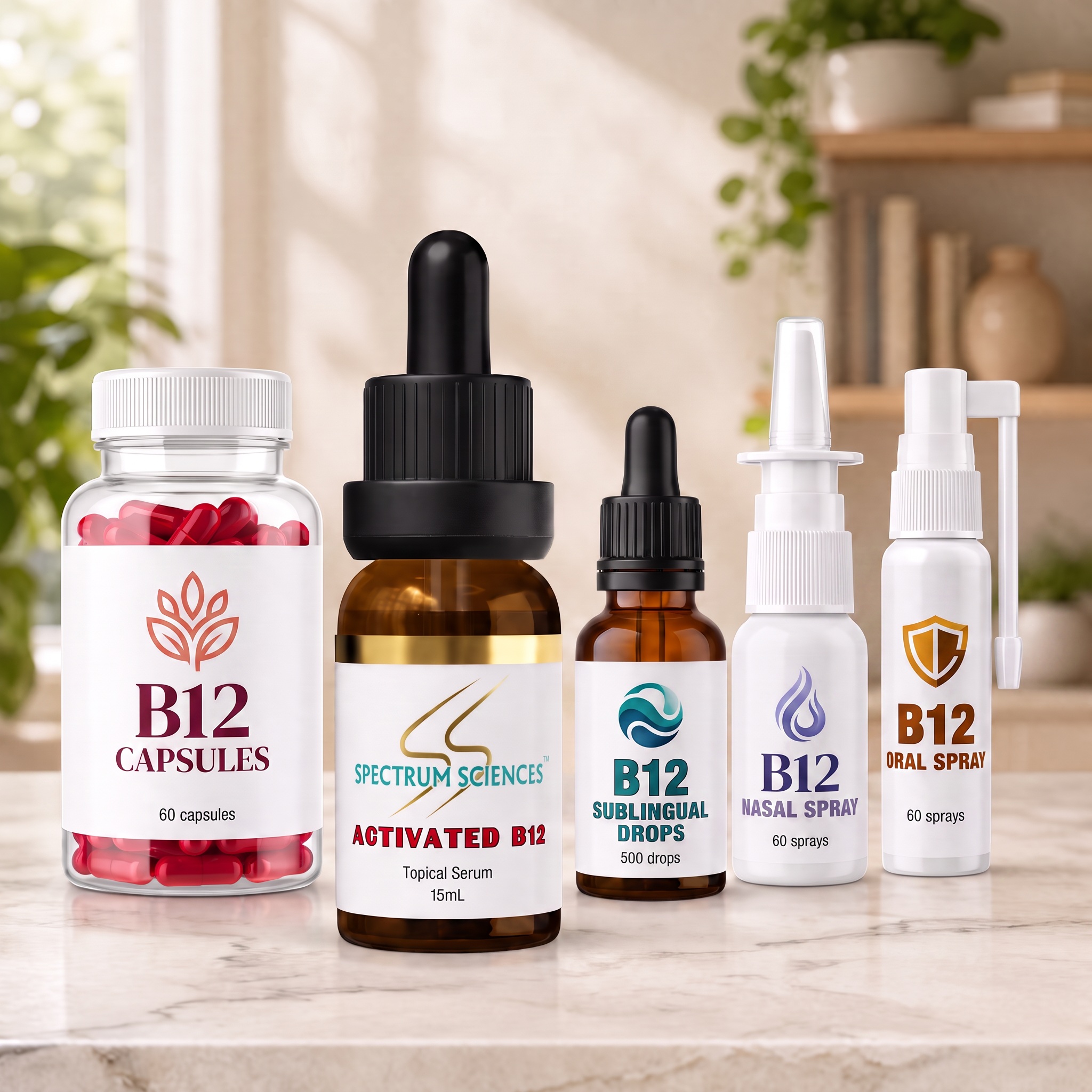
How Oral B12 Works and Where It Falls Short
Oral B12 (including capsules, tablets, lozenges, liquids, and sprays) is absorbed through the intestines, and that is where the trouble begins. The body relies on intrinsic factor to move B12 across the intestinal wall, and that mechanism can only handle a limited amount at a time.
Intrinsic factor acts like a gatekeeper. If the body does not make enough of it, or if the intestinal lining is damaged, a much smaller share of the oral dose reaches the bloodstream. This is why the absorption figure for oral B12 sits at roughly 1-2% for high-dose oral formulations, and it is also why some people feel no change from a daily pill. The pill is not failing because it is weak. It is failing because the digestive system cannot move enough of it into the body.
Cost is a factor that weighs into the decision of which form to take. One trial found that orally delivered vitamin B12 had lower treatment-associated costs than intramuscular vitamin B12, which is a meaningful factor for families managing a supplement budget.
What About Sprays?
B12 oral sprays, designed for absorption in the mucous membranes of the mouth, do not work according to that design. B12 is not absorbed in the mouth, and the dose just gets swallowed. It is an expensive oral supplement. If you prefer an oral supplement, and cannot do capsules, a liquid supplement is a more cost-effective form than an oral spray. There is no mechanism by which sublingual absorption of B12 occurs.
What About Intranasal B12?
Nasal absorption is rapid but considerably lower than intramuscular injection, and effectiveness may vary with formulation, nasal congestion, and administration technique. It may suit uncomplicated deficiency or maintenance therapy, while severe deficiency or neurologic symptoms generally require established medical treatment. We consider it more effective than oral formulations, albeit rather invasive for children and sensitive individuals (perhaps even more so than injections). Furthermore, the child must learn to inhale through the nose while the spray is administered. This is often a challenge not easily overcome.
What About Topical B12?
Topical B12 takes the non-oral idea further. A transdermal oil is applied to the skin, where the nutrient absorbs directly through the skin and into the body. This route bypasses the digestive tract completely, which means it also avoids the intrinsic factor bottleneck that limits oral absorption.
For parents, the appeal of a topical oil is simple: it removes the fight. There is no flavor to dislike, no lump to swallow, and no needle to fear. The oil can be worked into a routine in a way that a pill battle cannot. This is especially helpful for children with sensory sensitivities, who may react strongly to tastes, textures, and smells.
Furthermore, the absorption rate of transdermal B12 is very slow, which gives the advantage of sustained release of vitamin B12 into the bloodstream. This maintains an elevated serum level around the clock, allowing improved intracellular uptake.

Comparing Delivery Methods at a Glance
|
Method |
How It Is Given |
What Research Notes |
|---|---|---|
|
Injection |
Needle, usually in a clinic or daily at-home |
Nearly 100% absorption; delivers faster, more reliable results; invasive. |
|
Oral tablet/capsule |
Swallowed |
Absorption rate of 1-2%; ineffective in many cases. |
|
Sublingual liquids, lozenges, and sprays |
Held under the tongue or misted into the mouth |
Not absorbed sublingually. Matches oral absorption rate of 1-2%. |
|
Intranasal spray |
Misted into the nose |
Absorption matches or exceeds oral delivery, but falls short of injections and transdermal methods; invasive and requires synchronized inhale technique. |
|
Topical oil |
Applied to the skin |
Bypasses the digestive tract; avoids the intrinsic factor bottleneck of oral B12; simple application. |
No single method is right for every child. A child who fears needles may do well with an oral capsule or liquid. A child who refuses anything near the mouth may accept a topical oil. The only two methods shown to work reliably are injections and transdermal application. The better choice is the one the child will accept consistently, because a supplement only works if it actually gets into the body consistently.
Practical Tips for Parents of Children Who Refuse Vitamins
- Match the method to the child. If taste and texture are the problem, a spray or topical oil may be easier than a tablet.
- Build a routine. A topical oil can be applied after a bath or before bed, turning supplementation into a calm ritual instead of a battle.
- Watch for signs that absorption is the issue. If a child is still not seeing results despite taking oral B12, the problem may be the route, not the dose.
- Talk to your child's healthcare provider before adding any supplement.
Consistency matters more than perfection. A child who calmly receives a B12 dose every day will benefit more than a child who resists a stronger product twice a week. Whatever route you choose, the routine should feel safe and predictable for the child.

The Role of Testing and Functional Deficiency
Testing matters when choosing between B12 injections and oral supplements. Blood tests can look normal while cells are still short on B12, a situation that we call functional B12 deficiency.
Functional deficiency is not always obvious. A child can have normal B12 on a blood test yet still show signs that cells are struggling. For parents, this means the absence of a deficiency diagnosis does not necessarily mean the absence of a problem. The whole approach taken by Spectrum Sciences is built around this idea.
For families who have tried oral supplements or shots without seeing improvement, a functional deficiency may be the missing piece. The delivery method might have been fine, or the child might have skipped doses because the form was unpleasant. Either way, the outcome is the same: the body does not get the B12 it needs.
Spectrum Sciences offers our transdermal B12 oil as part of our B12 Protocol, along with companion products such as iodide oil, selenium oil, molybdenum oil, and Spectrum Synergy Multi. The brand was founded by parents of children with autism, and the product line exists to serve families with autistic children plus adults living with chronic fatigue, MS, and other neurological conditions. The approach is built around the idea that transdermal delivery bypasses the absorption limits of oral forms and supports methylation more directly. What the research in this article supports is simple: there are many ways to give B12, and the easiest one for your child is the one that actually happens, every day.
Frequently Asked Questions
Is oral B12 as effective as B12 injections?
Typically no, but oral B12 generally costs less than injected B12, which makes it an attractive option for families managing a supplement budget.
Why is B12 hard for a child to absorb?
The intestines can only absorb a limited amount of oral B12 because the body depends on intrinsic factor to carry the vitamin across the intestinal wall. Research puts high-dose oral B12 absorption at roughly 1-2%, compared with nearly 100% for injections. Topical B12 bypasses the digestive tract entirely, which is why some parents turn to a transdermal oil for a child who cannot absorb or will not swallow oral forms. That is our expertise at Spectrum Sciences.
Are B12 sprays better than tablets?
An oral spray is simply a higher-priced oral formulation that also performs poorly. There is no special B12 absorption mechanism that occurs in the mouth. If your child cannot swallow capsules, doesn't like the taste of a liquid product, and the parent insists on an oral formulation, an oral spray could be the best option. Some children will still resist a spray, however, and a topical oil can be an even gentler alternative.
A nasal spray delivers similar results, with small studies showing it may have an edge on traditional oral formulations. Only consider a nasal spray if it is the most convenient method of administration, allowing you to be consistent. Most people consider intranasal administration to be highly invasive.
Can topical B12 replace injections for my child?
Transdermal oil delivers B12 through the skin to bypass the digestive tract without needles. We developed Activated B12 Oil for this purpose. Speak with your child's healthcare provider before making any change in their supplement routine.